Basics
Free/Lifetime
Everything you need to organize your application.
- Course Finder & Tracker
- 15,000+ Offer Database
- Grade & Revision Trackere
- Basic Statement Builder
- Super-curricular Logger
THE UCAS PERSONAL STATEMENT Builder
From picking your topics to writing your final paragraph, the composer guides you through every part. Your super-curriculars, your courses, your experiences. All in one place when you need them.
Trusted by 80,000+ Students Globally
What you need to know
Two things. First, a genuine reason why you want to study the course. Second, evidence you've gone beyond your A-levels to explore the subject — books, papers, podcasts, projects, competitions, lectures. These are your super-curriculars.
What you did matters less than what you took from it. One academic paper you can speak to in depth will always beat a list of six activities you can barely describe. Admissions tutors at universities read thousands of statements. Depth is what gets noticed.
One more thing: UCAS now splits the personal statement into three questions. Most top universities — including Cambridge and LSE — advise you to largely ignore the question prompts and write it as one cohesive essay. The composer is structured the right way: Introduction, Body, Closing. Not UCAS's three questions.
What you need to know
Two things. First, a genuine reason why you want to study the course. Second, evidence you've gone beyond your A-levels to explore the subject — books, papers, podcasts, projects, competitions, lectures. These are your super-curriculars.
What you did matters less than what you took from it. One academic paper you can speak to in depth will always beat a list of six activities you can barely describe. Admissions tutors at universities read thousands of statements. Depth is what gets noticed.
One more thing: UCAS now splits the personal statement into three questions. Most top universities — including Cambridge and LSE — advise you to largely ignore the question prompts and write it as one cohesive essay. The composer is structured the right way: Introduction, Body, Closing. Not UCAS's three questions.
How it works
The composer is split into four sections.
Introduction, Body, Closing, and Split. Here's what each one does.
Answer one question: why do you want to study this subject? Aim for 400 to 800 characters. A specific moment, a book, something that sparked your interest. Not a generic opening — something that's yours. The reference panel on the right shows your course choices to keep you focused on what's relevant.
This is where your super-curriculars go. Click Add Paragraph, pick a super-curricular from your logged activities, and the reference panel generates a suggested structure for that paragraph — why you were interested, what you did, what you learned, how it connects to your course. You write it. The structure is there to guide you. Add two to four paragraphs. Go into depth on each one.
A short conclusion. Tie back to what you said in the introduction. Where you want to take your interest at university. Keep it brief — you've already made the case in the body.
Not a writing section. A live view of your full statement — character count, how it's distributed across sections, what's left to do. Use it to check you're on track before you copy and submit
How it works
The composer is split into four sections.
Introduction, Body, Closing, and Split. Here's what each one does.
Answer one question: why do you want to study this subject? Aim for 400 to 800 characters. A specific moment, a book, something that sparked your interest. Not a generic opening — something that's yours. The reference panel on the right shows your course choices to keep you focused on what's relevant.
This is where your super-curriculars go. Click Add Paragraph, pick a super-curricular from your logged activities, and the reference panel generates a suggested structure for that paragraph — why you were interested, what you did, what you learned, how it connects to your course. You write it. The structure is there to guide you. Add two to four paragraphs. Go into depth on each one.
A short conclusion. Tie back to what you said in the introduction. Where you want to take your interest at university. Keep it brief — you've already made the case in the body.
Not a writing section. A live view of your full statement — character count, how it's distributed across sections, what's left to do. Use it to check you're on track before you copy and submit
Before you write a word, the builder knows your five UCAS choices. The reference panel keeps your course information visible throughout, so every paragraph you write stays relevant to every university you're targeting. One personal statement goes to all five. Every sentence needs to work for all of them.
Course-aware writing
Topic-matched activities
No generic statements
Before you write a word, the builder knows your five UCAS choices. The reference panel keeps your course information visible throughout, so every paragraph you write stays relevant to every university you're targeting. One personal statement goes to all five. Every sentence needs to work for all of them.
Course-aware writing
Topic-matched activities
No generic statements

Before you write a word, the builder knows your five UCAS choices. The reference panel keeps your course information visible throughout, so every paragraph you write stays relevant to every university you're targeting. One personal statement goes to all five. Every sentence needs to work for all of them.
Course-aware writing
Topic-matched activities
No generic statements
In the Body section, select any super-curricular you've logged — a paper, a book, a project, a podcast — and the reference panel generates a suggested structure for that paragraph. What sparked your curiosity. What you did. What you learned. How it connects to your degree. You write the paragraph. The AI gives you the shape.
Based on what you've logged
Guides real depth
You write it
In the Body section, select any super-curricular you've logged — a paper, a book, a project, a podcast — and the reference panel generates a suggested structure for that paragraph. What sparked your curiosity. What you did. What you learned. How it connects to your degree. You write the paragraph. The AI gives you the shape.
Based on what you've logged
Guides real depth
You write it

In the Body section, select any super-curricular you've logged — a paper, a book, a project, a podcast — and the reference panel generates a suggested structure for that paragraph. What sparked your curiosity. What you did. What you learned. How it connects to your degree. You write the paragraph. The AI gives you the shape.
Based on what you've logged
Guides real depth
You write it
While you write, the right-hand panel shows you what you need for that section. In the introduction, it shows your course choices. In the body, it shows the AI-suggested structure for the super-curricular you've selected. You never have to switch tabs or dig through notes to remember what you wanted to say.
Three-column layout
Section-specific Guidance
Auto-saves
While you write, the right-hand panel shows you what you need for that section. In the introduction, it shows your course choices. In the body, it shows the AI-suggested structure for the super-curricular you've selected. You never have to switch tabs or dig through notes to remember what you wanted to say.
Three-column layout
Section-specific Guidance
Auto-saves
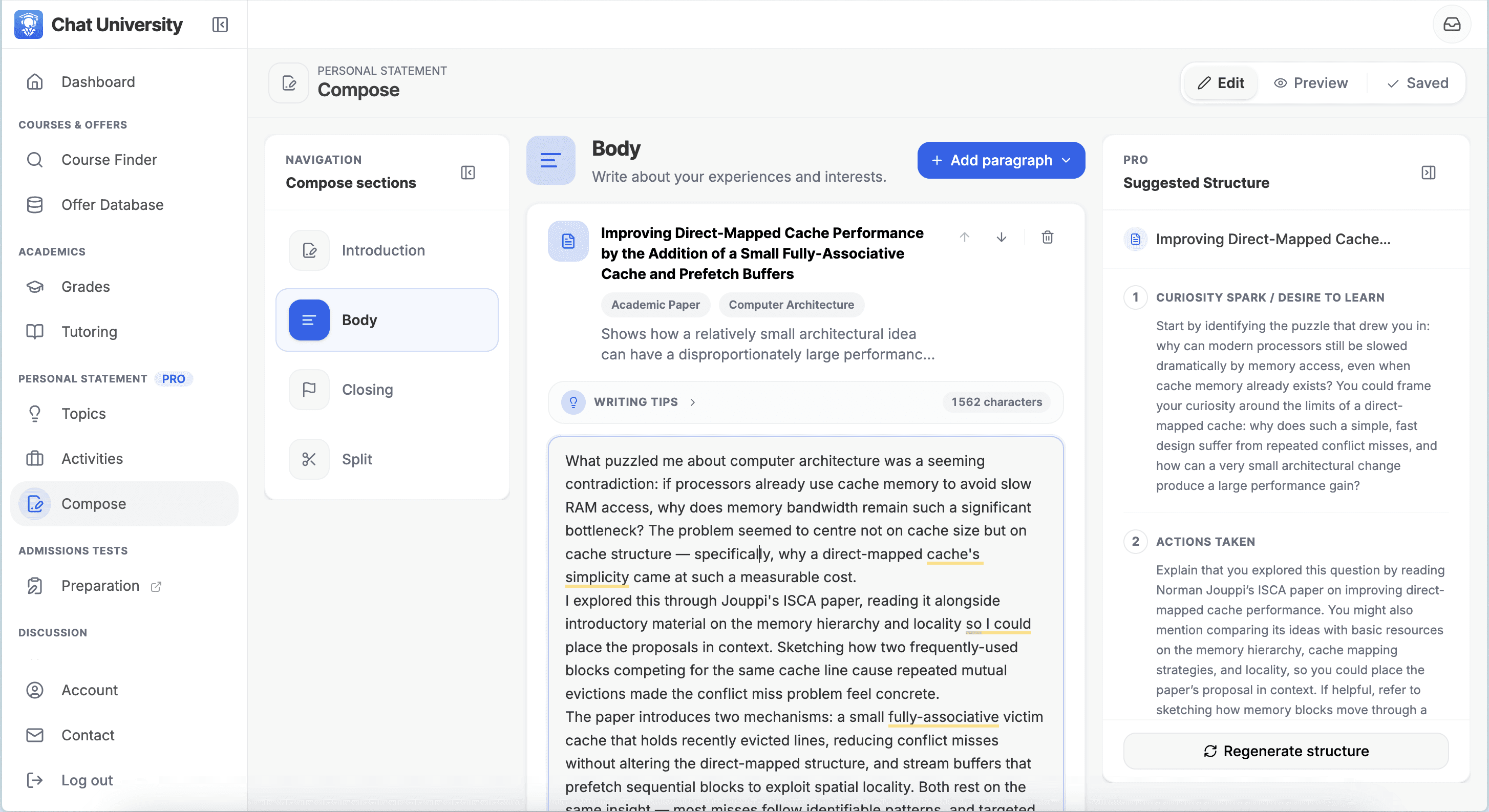
While you write, the right-hand panel shows you what you need for that section. In the introduction, it shows your course choices. In the body, it shows the AI-suggested structure for the super-curricular you've selected. You never have to switch tabs or dig through notes to remember what you wanted to say.
Three-column layout
Section-specific Guidance
Auto-saves
The Split view shows you everything you've written in one place — your full character count, how it's distributed across each section, and what still needs work. Check it before you copy your statement into UCAS. It's there to make sure nothing's missing and nothing's over.
Character count
Section breakdown
Review before submit
The Split view shows you everything you've written in one place — your full character count, how it's distributed across each section, and what still needs work. Check it before you copy your statement into UCAS. It's there to make sure nothing's missing and nothing's over.
Character count
Section breakdown
Review before submit

The Split view shows you everything you've written in one place — your full character count, how it's distributed across each section, and what still needs work. Check it before you copy your statement into UCAS. It's there to make sure nothing's missing and nothing's over.
Character count
Section breakdown
Review before submit
"I just wanted to say thank you for your help with my personal statement as I couldn’t have got into LSE without it!"
Ryan
Just wanted to give you an update on my offers following the few calls we had a few months ago. I’ve received all 5 decisions for Accounting and Finance with 4 contextual offers from KCL, Warwick, QMUL and City. I also want to thank you for all of the support as I couldn’t have gotten this far without your guidance. What you’re doing with Chat University is truly amazing and I wish you all the best
Aria
"I got my first offer from Warwick!!!! Couldn’t have done it without your help with the personal statement, so thank you!!!"
Safa
I hope you are well. Just wanted to get in touch to let you know I got offers for Chemistry from UCL, KCL, QMUL, and Durham. Thank you so much for your help. I definitely wouldn’t have gotten these offers if it weren’t for you. Wishing you the best.
Malaika
Taveesha here! Hope you're doing well. I got my personal statement reviewed by you back in December for Economics, and I remember you telling me to keep you updated. Well, I got an offer from my first choice LSE last week! Thank you so much for that review session, it definitely felt reassuring before submitting my application.

Taveesha
Just wanted to give you an update on my offers following the few calls we had a few months ago. I’ve received all 5 decisions for Accounting and Finance with 4 contextual offers from KCL, Warwick, QMUL and City. I also want to thank you for all of the support as I couldn’t have gotten this far without your guidance. What you’re doing with Chat University is truly amazing and I wish you all the best
Aria
I hope you are well. Just wanted to get in touch to let you know I got offers for Chemistry from UCL, KCL, QMUL, and Durham. Thank you so much for your help. I definitely wouldn’t have gotten these offers if it weren’t for you. Wishing you the best.
Malaika
"I got my first offer from Warwick!!!! Couldn’t have done it without your help with the personal statement, so thank you!!!"
Safa
Taveesha here! Hope you're doing well. I got my personal statement reviewed by you back in December for Economics, and I remember you telling me to keep you updated. Well, I got an offer from my first choice LSE last week! Thank you so much for that review session, it definitely felt reassuring before submitting my application.

Taveesha
"I just wanted to say thank you for your help with my personal statement as I couldn’t have got into LSE without it!"
Ryan
Just wanted to give you an update on my offers following the few calls we had a few months ago. I’ve received all 5 decisions for Accounting and Finance with 4 contextual offers from KCL, Warwick, QMUL and City. I also want to thank you for all of the support as I couldn’t have gotten this far without your guidance. What you’re doing with Chat University is truly amazing and I wish you all the best
Aria
"I got my first offer from Warwick!!!! Couldn’t have done it without your help with the personal statement, so thank you!!!"
Safa
I hope you are well. Just wanted to get in touch to let you know I got offers for Chemistry from UCL, KCL, QMUL, and Durham. Thank you so much for your help. I definitely wouldn’t have gotten these offers if it weren’t for you. Wishing you the best.
Malaika
Taveesha here! Hope you're doing well. I got my personal statement reviewed by you back in December for Economics, and I remember you telling me to keep you updated. Well, I got an offer from my first choice LSE last week! Thank you so much for that review session, it definitely felt reassuring before submitting my application.
Taveesha
Just wanted to give you an update on my offers following the few calls we had a few months ago. I’ve received all 5 decisions for Accounting and Finance with 4 contextual offers from KCL, Warwick, QMUL and City. I also want to thank you for all of the support as I couldn’t have gotten this far without your guidance. What you’re doing with Chat University is truly amazing and I wish you all the best
Aria
I hope you are well. Just wanted to get in touch to let you know I got offers for Chemistry from UCL, KCL, QMUL, and Durham. Thank you so much for your help. I definitely wouldn’t have gotten these offers if it weren’t for you. Wishing you the best.
Malaika
"I got my first offer from Warwick!!!! Couldn’t have done it without your help with the personal statement, so thank you!!!"
Safa
Taveesha here! Hope you're doing well. I got my personal statement reviewed by you back in December for Economics, and I remember you telling me to keep you updated. Well, I got an offer from my first choice LSE last week! Thank you so much for that review session, it definitely felt reassuring before submitting my application.
Taveesha
pricing
Trusted by 80,000+ Students Globally
pricing
Trusted by 80,000+ Students Globally
Q&A
The logger is where you track everything you've read, watched, and done — before you start writing. The composer is where you write. When you get to the Body section and add a paragraph, your logged super-curriculars are right there to pick from. The two work together.
Two to four is the standard. Most strong statements have three. Each paragraph should cover one super-curricular in depth — why you were interested, what you did, what you learned, how it connects to your course. Depth over quantity, every time.
Not strictly. UCAS says the order doesn't matter — universities read the full statement in one go. Cambridge, LSE, and most Russell Group universities want to see subject engagement above everything else. The composer uses Introduction, Body, and Closing — that's the structure that works.
Only if it's directly relevant to the course. Most work experience isn't — a finance internship doesn't strengthen an economics application in the way a book on behavioural economics does. If you shadowed a doctor and you're applying to medicine, that's relevant. If you're not sure, it probably isn't.
Once you're happy with what you see in the Split view — full character count, all sections complete. Copy the full statement and paste it directly into your UCAS application. The builder doesn't submit anything for you.
Oxbridge and medicine deadlines are in mid-October. Standard Russell Group deadlines are end of January. Most students underestimate how long it takes. If you're in Year 12, start logging your super-curriculars now. Writing becomes much easier when you already have material to work from.
Q&A
The logger is where you track everything you've read, watched, and done — before you start writing. The composer is where you write. When you get to the Body section and add a paragraph, your logged super-curriculars are right there to pick from. The two work together.
Two to four is the standard. Most strong statements have three. Each paragraph should cover one super-curricular in depth — why you were interested, what you did, what you learned, how it connects to your course. Depth over quantity, every time.
Not strictly. UCAS says the order doesn't matter — universities read the full statement in one go. Cambridge, LSE, and most Russell Group universities want to see subject engagement above everything else. The composer uses Introduction, Body, and Closing — that's the structure that works.
Only if it's directly relevant to the course. Most work experience isn't — a finance internship doesn't strengthen an economics application in the way a book on behavioural economics does. If you shadowed a doctor and you're applying to medicine, that's relevant. If you're not sure, it probably isn't.
Once you're happy with what you see in the Split view — full character count, all sections complete. Copy the full statement and paste it directly into your UCAS application. The builder doesn't submit anything for you.
Oxbridge and medicine deadlines are in mid-October. Standard Russell Group deadlines are end of January. Most students underestimate how long it takes. If you're in Year 12, start logging your super-curriculars now. Writing becomes much easier when you already have material to work from.
Community

17K Followers
Stay up to date with the latest news about UK University applications!
17K followers
Stay up to date with the latest news about UK University applications!

3k followers
Join our community on Instagram - with a dedicated account for parents!
3k Followers
Join our community on Instagram - with a dedicated account for parents!
Community
17K followers
Stay up to date with the latest news about UK University applications!
3k followers
Join our community on Instagram - with a dedicated account for parents!